
About the Collin County District Clerk's Office
The Collin County District Clerk is Michael Gould. The office is the registrar, recorder, and custodian of pleadings, filings, and court records for the district courts of Collin County. It serves all 15 district courts, which hear civil, family, and felony criminal cases. The clerk's staff numbers more than 90 people. They safeguard millions of court records and take in more than 25,500 new case filings each year.
The job goes well past filing paper. The District Clerk runs jury services for every statutory district, county, and justice of the peace court in Collin County. The office manages felony payment plans, oversees more than $10 million in court registry and related accounts, and handles bail bond forfeitures, tax suits, and statutory funds. The Russell A. Steindam Courts Building on Bloomdale Road houses the office and the courts it serves.
Collin County District Clerk
Clerk: Michael Gould
2100 Bloomdale Rd.
McKinney, TX 75071
(972) 548-4100
Mon-Fri, 8:00 a.m.-4:30 p.m.
Passport walk-ins: Wed, 7:00 a.m.-3:00 p.m.
What the District Clerk Does in Collin County
The District Clerk handles the back end of every district court case. The office files pleadings, keeps the official record, issues process, and collects court fees. It also indexes and stores judgments so they can be found and copied later. Because the office serves felony, family, and large civil dockets, the records it holds tend to be the ones people most often need for legal or personal reasons.
The main duties of the office include the following.
- File and store district court pleadings, motions, orders, and judgments.
- Keep felony, family, divorce, and higher-value civil case records.
- Run jury services for district, county, and justice of the peace courts.
- Collect filing fees, manage court registry accounts, and process felony payment plans.
- Handle bail bond forfeitures, tax suits, and certain statutory funds.
The County Clerk handles a separate set of records. Misdemeanor A and B cases, county court at law civil suits, marriage licenses, and land records go through that office instead. For those, see the Collin County Clerk page. This split clerk system is the single thing most worth learning before any records request.
Searching District Court Records Online
Many district court files are searchable for free. The county runs Judicial Online Search and Case Search, both reached through the official case information page. A name or a cause number is enough to start. For civil document images, the county points filers to re:SearchTX, the statewide portal for civil court records.
The re:SearchTX system lets registered users view and pull civil case documents that local result lists do not show in full. It works alongside the county's own search tools rather than replacing them.
The re:SearchTX public portal is the statewide tool for civil court records and document images.
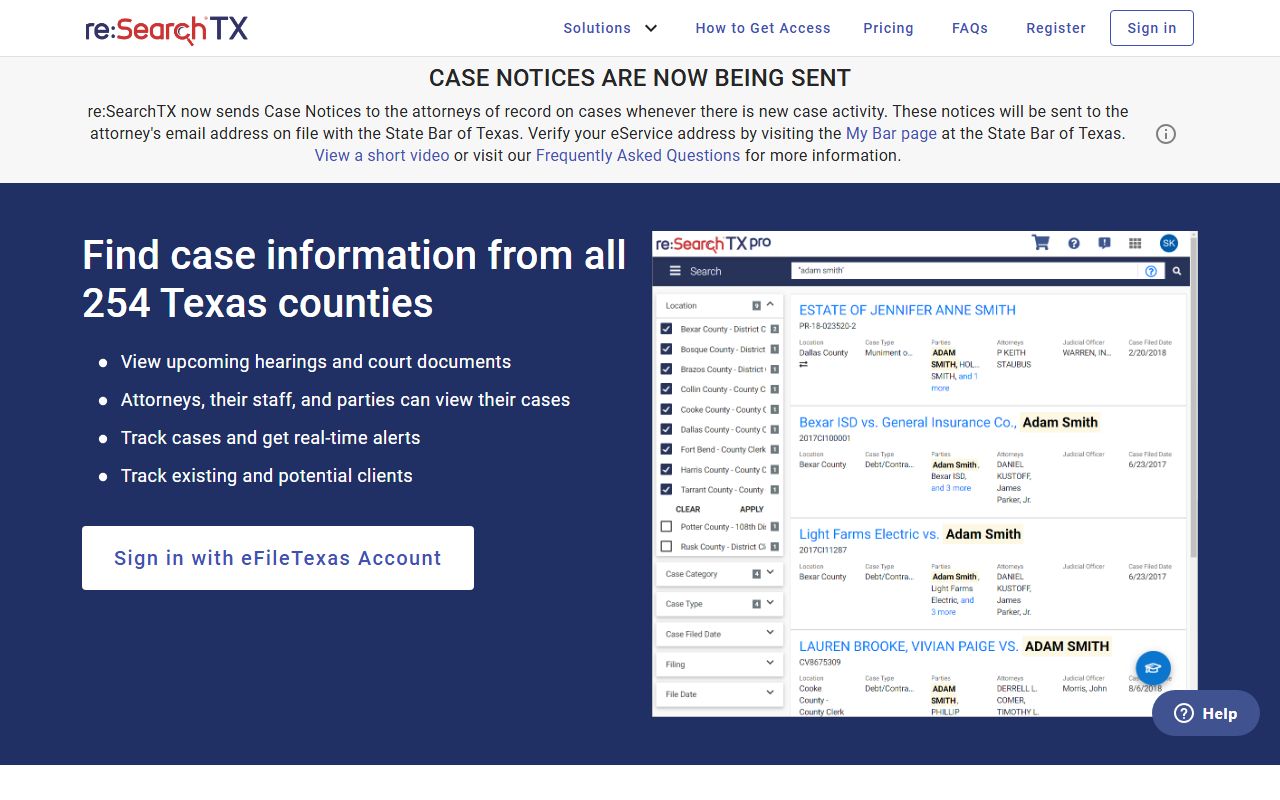
It is the place to look when a county result list shows a civil case but not the underlying filing. For full case history across types, the Collin County court records page walks through the county search tools step by step.
Online Coverage and Older Records
Not every case is online. The District Clerk's coverage starts at fixed dates, and anything older needs a written request. District court criminal cases filed or completed from 1988 to the present sit in the online case search. Civil cases filed or completed from 1984 forward are online too. The gap before those dates is large, so older files take an extra step.
Criminal case searches for cases completed from the 1800s through 1987, and civil searches for cases completed from the 1800s through 1983, must be requested in person or by mail or email. The District Clerk Record Request Form is the tool for that. Each record search at the office costs $5, and the office does not run record searches by phone.
Online coverage at a glance:
District court criminal: 1988 to present online; 1800s through 1987 by request.
District court civil: 1984 to present online; 1800s through 1983 by request.
Note: A written search request should include the person's full name and date of birth, a self-addressed stamped envelope, and a check or money order for the $5 fee.
How to Request a Certified Copy
A certified copy is a clerk-verified document used for court, legal, or official needs. An uncertified printout from an online search does not carry the same weight. For divorce decrees, judgments, and other district court documents, the District Clerk issues the certified version. The steps below follow the office's own record request process.
- Identify the case. Have the cause number ready, or the party names and an estimated filed date if you do not.
- Get the District Clerk Record Request Form from the office or the documents and forms page.
- Mark the document you want, the number of copies, and the certified copy box, which adds a $5 certificate fee per document.
- Submit the form with payment by check, money order, or cash, and choose mail back, pick up, or email delivery.
Searches are normally processed within one to three days of receipt. The form says to allow up to 10 business days. If you ask for mail delivery, include a postage-paid envelope.
Record Request Form Fields
The District Clerk Record Request Form asks for requester details, case details, payment, and delivery choices. Knowing the fields ahead of time makes the form quick to fill. The table below lists the main fields the office uses.
| Field | Required | Notes |
|---|---|---|
| Name, Address, Phone, Email | Yes | Requester contact details for delivery and follow-up. |
| Case Number | No | Cause number if known; speeds the search. |
| Party / Litigant Names | No | Used to locate a case when the number is unknown. |
| Estimated Filed Date | No | Helps narrow a search without a cause number. |
| Date / Title of Document | No | Repeated rows for each document requested. |
| Requesting Certified Copy | No | Adds $5 per certification per document. |
| CD Requested | No | $20 per disk option. |
| Delivery Method | Yes | Mail back with postage-paid envelope, pick up, or email. |
| Payment Type | Yes | Check, cash, or card for copies; DL number and date of birth needed if paying by check. |
The form also has clerk-use fields for the search result, the date completed, the staff member, and the total charged.
Collin County District Clerk Fees
The District Clerk charges set amounts for searches and copies. The fees come from the office's own fee pages and the record request form. A search without a cause number costs $5. Plain copies run $1 per page, and certified copies add a $5 certificate fee per document. The amounts below cover the most common requests.
| Item | Amount |
|---|---|
| Record search when cause number or document is unknown | $5.00 |
| Noncertified paper copy | $1.00 per page |
| Noncertified electronic copy | $1.00 up to 10 pages, then $0.10 per added page |
| Certified paper copy | $1.00 per page plus $5.00 per document for the certificate and seal |
| Copy on disk over 100 pages | $20.00 per disk |
Bring a check, money order, or cash to the office. The current civil and family fee schedule is posted as a PDF on the District Clerk's documents and forms page.
Common District Clerk Forms
The District Clerk posts the forms most filers reach for. The list includes the record request form, civil and criminal fee schedules, expunction forms, and standing orders for sensitive data. Self-represented filers can also use Guide & File to build certain court forms step by step.
- Documents and forms list - record request form, fee schedules, and local rules.
- Guide & File - guided forms for certain civil, family, and protective-order cases.
- Texas State Law Library guides - plain-language help on divorce, name changes, and more.
For divorce records and decrees held by this office, the marriage and divorce records page explains the search and copy process in full.
E-Filing and Mail Filings
Most new civil, family, and probate cases in Collin County are filed online. The state portal is eFileTexas, and the District Clerk accepts electronic filings through it. Attorneys and self-represented filers both use the system, and Guide & File can generate some forms for people without a lawyer.
The official eFileTexas system handles electronic filing statewide. Older records and certain requests still come in by mail or email using the record request form, and the office processes those during regular business hours.