
What Probate Covers in Collin County
Probate is the court process that settles an estate. When someone dies, the court oversees how the will is proven, how debts get paid, and how property passes to heirs. Collin County has a dedicated Probate Court, Probate Court 1, presided over by Judge Sarah Duff. The court's official jurisdiction reaches further than wills alone. It covers probate cases, inheritance matters, guardianship proceedings, and involuntary mental commitment actions.
That last category, mental commitment, is why some probate files carry strict privacy. Guardianship cases can hold medical detail too. The court sits at the Russell A. Steindam Courts Building in McKinney, the same campus as the district courts and the District Clerk. Uncontested probate and guardianship hearings are often handled by Zoom, and the court points users to its Forms and Information page for hearing instructions.
Probate work touches many lives. It decides who manages an estate, who inherits, and who looks after a person who can no longer manage on their own. Because the stakes are high, the court keeps a careful paper trail. That trail is what becomes the searchable record. Most of it is open to the public, which is why a probate search can confirm whether an estate was opened, who the executor is, and whether the case has closed.
Probate Terms Defined
Probate filings lean on a handful of legal words. A quick guide helps when you read a case index or a court order. Here are the terms that come up most often in Collin County probate cases.
- Testator
- The person who made the will.
- Executor
- The person named in a will to carry out its terms.
- Administrator
- A person the court appoints to settle an estate when there is no executor.
- Intestate
- Dying without a valid will, so state law decides who inherits.
- Guardianship
- A court process to manage the person or estate of an incapacitated adult or a minor.
- Conservatorship
- A court-appointed role to manage another person's care or property.
How to Search Collin County Probate Records
Probate cases are part of the county's online Case Search. Active probate cases sit in the County Court at Law structure, and historical probate cases run from 1984 to the present. Anything filed before 1984 needs a manual case record search through the proper clerk. To pull probate cases online, use Judicial Online Search or Case Search and set Probate as a case-type filter.
- Open the county's online case tool and choose Case Search or Judicial Online Search.
- Enter the decedent or party name, the case number, or the case style if you have it.
- Select Probate in the case-type filter and County in the court-type filter to narrow the list.
- Review the results, then request certified copies or letters from the proper clerk if you need court-ready documents.
The probate search fields mirror the rest of the county's case tools. The table below shows what you can enter to find a probate case.
| Field Label | Type | Required | Notes / Format |
|---|---|---|---|
| Search | Text | No | Decedent or party name, case number, case style, attorney, or judicial officer. |
| Case Types - Probate | Checkbox | No | Select Probate to narrow the result list. |
| Court Types - County | Checkbox | No | Probate appears under the county and probate court structure. |
| Filed Date Range | Date | No | From and To fields, format MM/DD/YYYY. |
| Case Status | Dropdown | No | Select a status to filter open or closed cases. |
Probate Court in Collin County
One court handles the bulk of probate work in the county. Probate Court 1 is the dedicated statutory probate court, and Judge Sarah Duff hears its docket. The contact card below has the court's location and main phone. Filings go through eFileTexas unless an exemption applies, and many uncontested hearings happen by Zoom.
Collin County Probate Court 1
Russell A. Steindam Courts Building
2100 Bloomdale Rd. #12010
McKinney, TX 75071
(972) 548-6463
Because uncontested probate and guardianship matters are often set on Zoom, check the court's Forms and Information page for the current hearing instructions before a scheduled date.
Texas Probate Routes
Texas offers more than one path through probate, and the right one depends on the estate. Some estates qualify for a light-touch process. Others need full court supervision. The route also shapes how long the case stays open and how much of it lands in the file.
- Independent administration - the common Texas route with reduced court oversight when a will or the heirs and court allow it.
- Dependent administration - more court-supervised, requiring approval for many steps.
- Muniment of title - a Texas way to admit a will as proof of title without a full administration when appropriate.
- Small estate affidavit - a simplified process for qualifying small estates.
- Guardianship - the process for an incapacitated adult or a minor, with ongoing reports and oversight.
The small estate affidavit path comes from Texas Estates Code Chapter 205, which lets certain modest estates skip formal administration. You can read the rules on the official statute site. The Texas Estates Code Chapter 205 small estate affidavit statute sets the dollar limits and the conditions a family must meet.
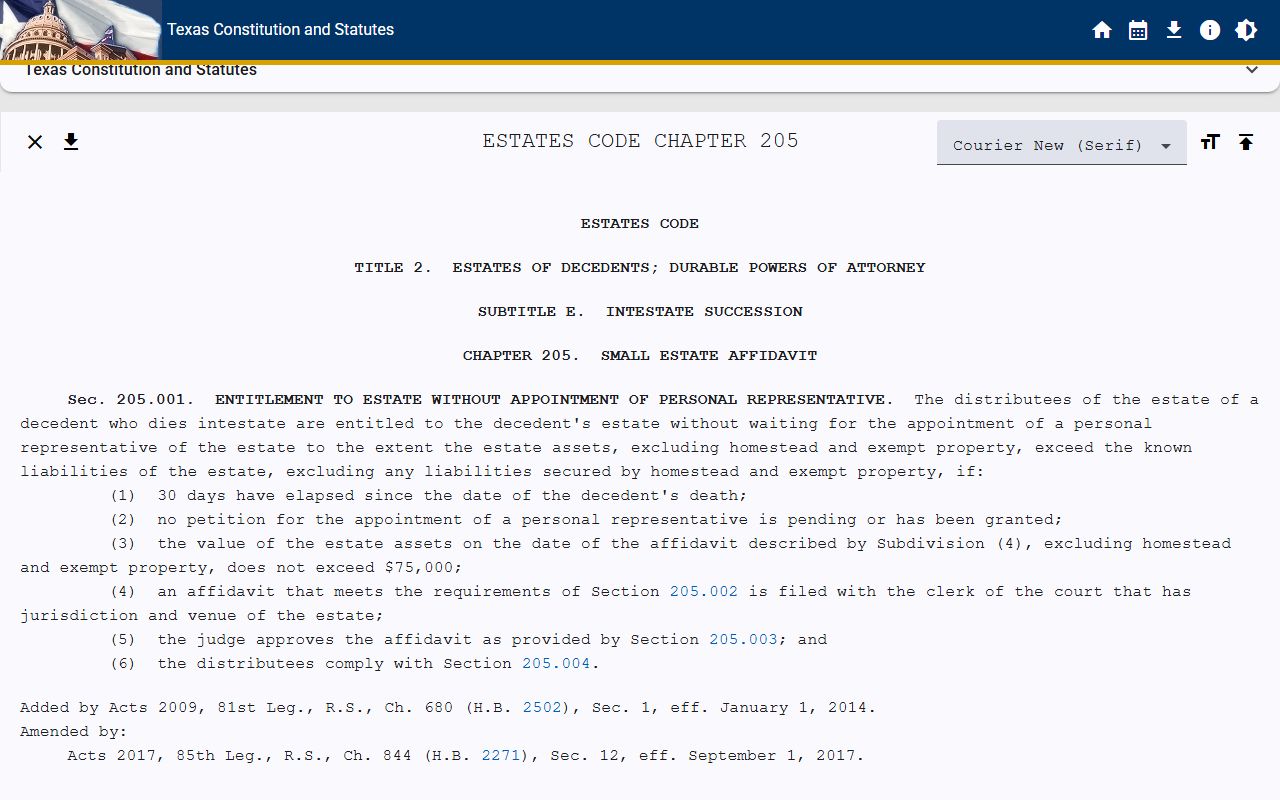
It is a useful first read when an estate is small and there is no need to open a full administration in Collin County.
What Collin County Probate Records Show
A probate file grows as a case moves. It can hold the application to probate a will, the original will and any codicils, proof of death, and the oath of the executor or administrator. Once the judge admits the will, the file gains the order admitting it and the letters testamentary or letters of administration. Later filings add the inventory, appraisement, and list of claims, plus accountings and a final order.
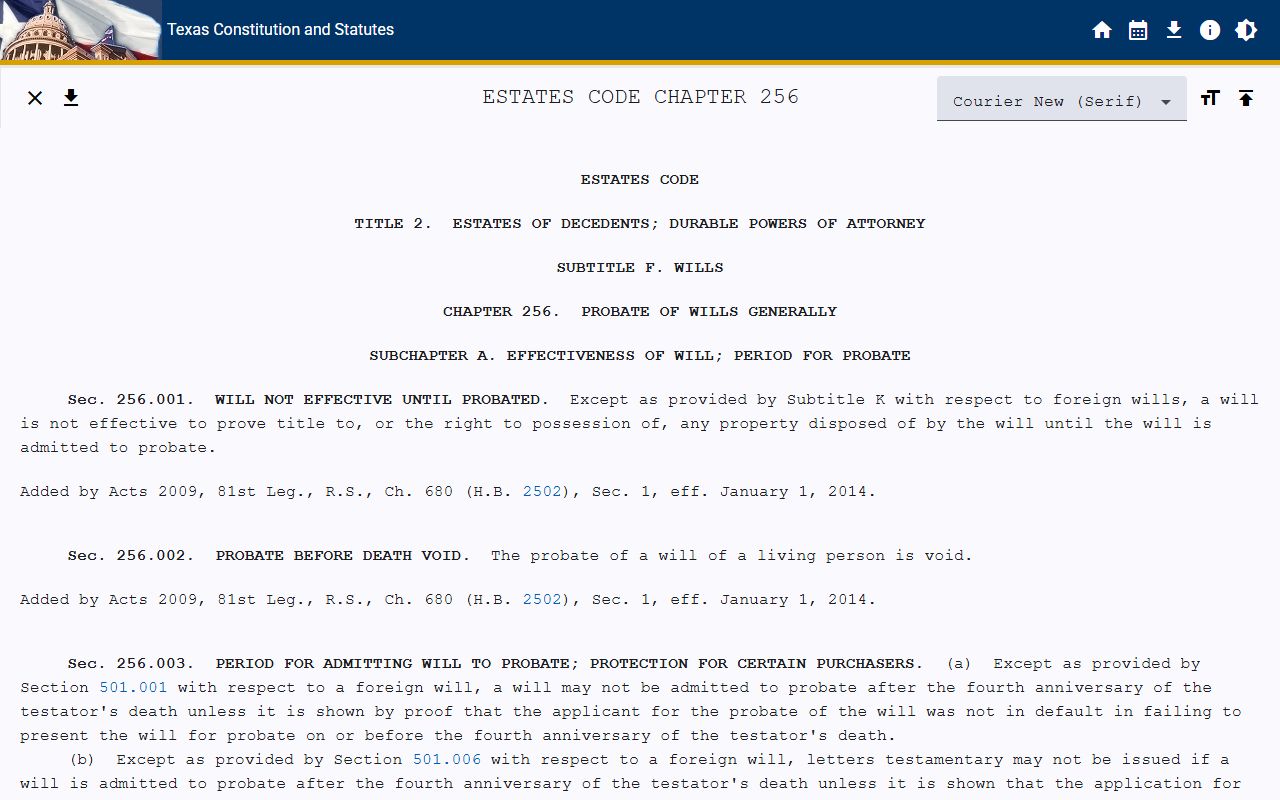
The legal backbone for admitting a will sits in the Estates Code. Texas Estates Code Chapter 256 covers the probate of wills, including who may apply and what the court must find. The Texas Estates Code Chapter 256 probate of wills statute lays out the steps a court follows to admit a will.
Guardianship cases add their own papers, such as a physician's certificate, an annual report on the person, and an annual accounting of the estate.
A heirship case follows a different track. When someone dies without a will, the court can be asked to declare who the legal heirs are. That file holds an application to determine heirship and a judgment declaring heirship. Other common entries across estate files include notices, citations, returns of service, bonds posted by an administrator, and the final order that closes the case. Each filing adds to the public record unless a judge has sealed it.
Note: Online results show the docket and party data, but full document images and certified letters come from the proper clerk, not the quick search screen.
Probate Filing and Copy Fees
Filing fees for probate are set at the county level, and the schedule can change. The county does not publish a single fixed probate fee table that this page can quote, so confirm current filing costs with the County Clerk or County Court fee schedule before you file. What is fixed are the District Clerk's copy and certification charges, which apply when you order court-ready copies of filed documents.
| Item | Amount |
|---|---|
| Probate application filing fee | Confirm with County Clerk / County Court schedule |
| Guardianship application filing fee | Confirm with County Clerk / County Court schedule |
| Noncertified paper copy | $1.00 per page |
| Certified copy certificate fee | $5.00 per document |
So a certified probate document costs $1 per page plus the $5 certificate fee. For the filing fee itself, the County Clerk and County Court fee schedule is the right source.
Restricted Probate Records
Not all probate matters are open to the public. Involuntary mental commitment actions are handled by the Probate Court, but those filings often contain medical and psychiatric information protected by state and federal privacy law. A public docket may show that a case exists, while the substance stays sealed. Guardianship records can carry the same kind of sensitive detail, especially when they involve a minor or a person's health.
Other estate files may be sealed by court order under the civil sealing rules. When a record is restricted, the index might show a status but withhold the documents. To view a sealed record, a person usually has to file a motion in the court that sealed it and show a legal reason. For the broader rules on what gets redacted across county files, see Collin County public records.