
About the Collin County Clerk's Office
The Collin County Clerk is Stacey Kemp. The office is the keeper of county-level records and a clerk for the county courts at law and the probate court. It records and stores documents that touch nearly every resident at some point: deeds, marriage licenses, birth and death certificates, assumed names, and more. The County Clerk also receives Commissioners Court minutes, orders, oaths, and official bonds, which are indexed and scanned for safekeeping.
The main McKinney office sits in the county complex on Bloomdale Road. Court record requests are handled at the courts building, while real property and vital records run through the main office. The split between this office and the District Clerk is the key thing to learn before any records request.
Collin County Clerk - McKinney
Clerk: Stacey Kemp
2300 Bloomdale Rd.
McKinney, TX 75071
(972) 548-4185
Mon-Fri, 8:00 a.m.-4:00 p.m.
County Court Record Requests
2100 Bloomdale Rd., Suite 12165
McKinney, TX 75071
Civil: (972) 548-6423
Criminal: (972) 548-6420
cclclerks@co.collin.tx.us
Note: The County Clerk's Plano office at 900 E. Park Blvd. is listed as closed until further notice due to flooding, so confirm service routing before relying on that location.
What the County Clerk Does in Collin County
The County Clerk records, indexes, and stores a broad set of public documents. The office acts as clerk for the county courts at law and the probate court, so it holds those case files. It also issues marriage licenses, records land documents, files assumed names, and keeps many vital records. Because the duties span courts, property, and personal records, the office is one of the busiest record keepers in the county.
The main duties of the office include the following.
- Keep county court at law records, including Class A and B misdemeanors and civil suits within jurisdiction.
- Serve as probate clerk for the county's probate court filings.
- Issue and record marriage licenses and keep historical marriage records.
- Record deeds, plats, liens, foreclosures, and other real property documents.
- File assumed names, marks and brands, military discharge records, and birth and death certificates.
- Keep Commissioners Court minutes, orders, oaths, and official bonds.
Felony, family, child support, divorce, and higher-value civil suits are not County Clerk records. Those belong to the District Clerk. The county court at law civil limit currently runs from $500 to $325,000, so larger civil suits move up to district court.
Searching County Clerk Records Online
Land and official public records are searchable through the County Clerk's online portal. The system covers deeds, liens, plats, and other recorded documents. A name, a document number, or a recording date helps narrow the results. Free searching is available, though printable certified PDFs require registration and payment under the county's instructions.
The portal is the fastest way to confirm a recorded document before ordering a copy. It pulls from the same official index the clerk maintains.
The County Clerk's official records search portal is the public tool for land and recorded documents.
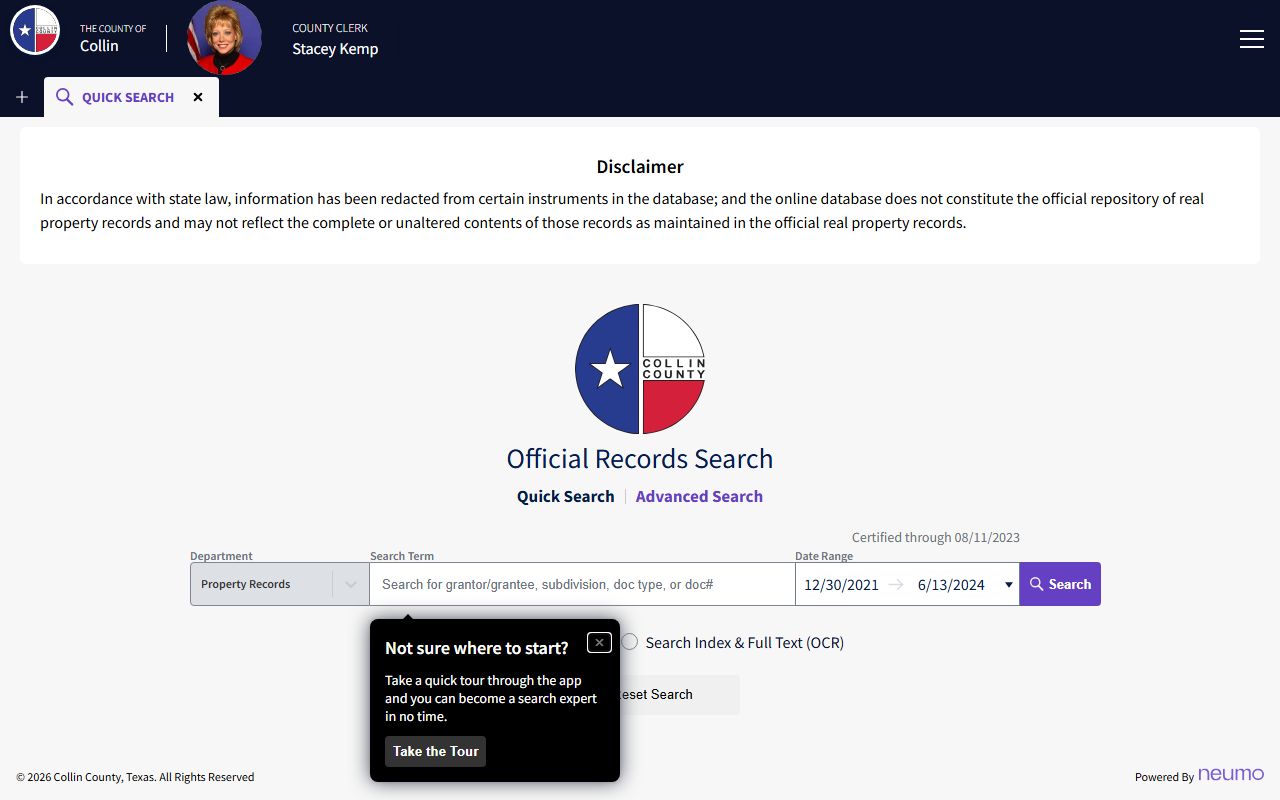
Once you have a document number from the portal, the property records copy request form lets you order a certified or plain copy. For county court at law cases, a separate web request form applies.
County Court at Law Records
The County Clerk holds the case files for the county courts at law. These courts hear Class A and B misdemeanors and civil suits within their jurisdiction. Document requests through the County Clerk Record Request Form cover misdemeanor A and B charges and county civil lawsuits within the jurisdictional limit. The current County Clerk page lists that civil range as $500 to $325,000.
Anything above that range, plus felony, family, child support, and divorce cases, goes to the District Clerk instead. The web form is free to submit, though copy fees apply once the documents are pulled. Civil and criminal requests use different phone lines at the courts building.
For the courts themselves, judges, and contact numbers, see the Collin County Courts at Law page. For broader open-records routing, see public records.
Marriage Licenses and Genealogy Records
Marriage licenses in Collin County are County Clerk records. The McKinney office issues licenses, and certified copies of marriage licenses, birth certificates, and death certificates can now be ordered online through the county's vital records provider. Texas Family Code Chapter 2 governs license issuance, including the waiting period and the lack of a blood test requirement.
The County Clerk's Genealogy Corner holds a deep marriage archive. More than 8,000 licenses dated 1884 through 1949 have been scanned, indexed, and made searchable online. The archive reaches back more than a century, which makes it a useful tool for family history work.
Divorce records are a different matter. Divorce is a district court case, so divorce decrees live with the District Clerk, not the County Clerk. For both sides, see marriage and divorce records.
How to Request a Certified Copy
A certified copy is a clerk-verified document accepted for legal and official purposes. The County Clerk issues certified copies of recorded documents, marriage licenses, and county court records. The steps below follow the office's property records copy request process.
- Find the document number through the official records search portal or the publicsearch index.
- Complete the property records copy request form, listing each document number, whether you want it certified, and the number of copies.
- Choose delivery: certified copies are mailed to an address; noncertified copies can be emailed.
- Pay by card through the secure payment fields, making sure the billing ZIP matches the cardholder's address, then submit the form.
For county court at law case documents, use the County Clerk Record Request web form instead, which routes civil and criminal requests to the courts building.
Property Records Copy Request Fields
The property records copy request form asks for requester details, document numbers, certification choices, delivery, and card payment. Filling it in is quicker when you already have the document numbers. The table below lists the main fields.
| Field | Required | Notes |
|---|---|---|
| Date, From, Email, Phone | Yes | Requester contact and request date. |
| Document Number | Yes | Up to six rows; get numbers from the publicsearch index. |
| Certified Copy (Y/N) | No | Mark yes or no for each document. |
| Number of Copies | Yes | Count requested per document. |
| Address for Certified Copies | Conditional | Required when certified copies are mailed. |
| Email for Documents | Conditional | For noncertified copies only. |
| Authorized Signature | Yes | Authorizes the card charge. |
| Card Type, Number, CVV, Exp Date | Conditional | Visa, Mastercard, Amex, or Discover. |
| Billing Address / ZIP | Conditional | Must match cardholder billing ZIP or the charge declines. |
A separate notarized form applies to nondisclosure records for county court at law cases, with a stated five-business-day processing time.
Collin County Clerk Fees
The County Clerk charges set amounts for copies and certifications. The fees below come from the office's copy request forms and the Commissioners Court copy schedule. Plain copies run $1 per page across most record types, and a certification adds $5. County court at law copies follow the same paper and certified-copy pattern.
| Item | Amount |
|---|---|
| Noncertified paper copy | $1.00 per page |
| Noncertified electronic copy | $1.00 up to 10 pages, then $0.10 per added page |
| Certified copy | $5.00 per document plus the copy cost |
| Commissioners Court copies | $1.00 per page |
| Commissioners Court certification | $5.00 |
Commissioners Court copies on disk are priced on request; contact the County Clerk for details. Card payment is built into the property records copy request form. If you pay by check, the office requires the check to carry a pre-printed name, full address, routing number, account number, and check number; checks without that pre-printed information are rejected.
Common County Clerk Forms
The County Clerk posts its forms and instructions online. The list includes the property records copy request form, the county court record request web form, the nondisclosure record request form, and land-record search instructions.
- Forms and documents list - copy request forms and instructions.
- County Clerk Record Request web form - for misdemeanor A/B and county civil documents.
- Official records search portal - search recorded land and official records.
For wills, guardianship, and estate filings handled by the probate court, see probate records, since the County Clerk acts as probate clerk for those cases.