
How to Find Recently Released Collin County Inmates
Collin County does not run a separate "released inmates" page. Instead, the same inmate list does double duty. The sheriff's inmate page says the roster includes all current inmates and everyone released in the past 24 hours. So for very recent releases, the live roster is your main local source. Search the county's Judicial Online Search by name or by sheriff's office number, then check the Inmate tab. A person released within the day should still show.
If the release is older than 24 hours, that name drops off the roster. At that point, call the jail to confirm. The Detention Bureau records line is (972) 547-5100, and the visitation packet line is (972) 547-5200. You can also open the linked criminal case to see how it ended. The release workflow runs through the jail's Admissions and Release Section, and timing depends on bond acceptance, any case holds, outstanding warrants, and paperwork.
The county's official path for an older release is to run Judicial Online Search first, then contact the Detention Bureau if the search does not answer the question. A name search there can pull the criminal case and any warrant tied to it. If the search shows no current custody and the case is closed, that often points to a completed release, though only the jail can confirm the date for a release outside the 24-hour window. Follow the steps below to work through it in order.
- Open the Judicial Online Search global portal and search by name or sheriff's office number.
- Check the Inmate tab plus the linked criminal case and warrant tabs.
- If the person is not listed and the release may be older than a day, call the Detention Bureau at (972) 547-5100.
- If the person may have gone to state prison, switch to the TDCJ offender search.
- If the person may be in federal custody, use the BOP inmate locator instead.
For the live roster and booking detail, start at Collin County inmate records. That page covers the search box, the fields, and what a profile shows.
Setting Up Release Notifications
The reliable way to catch a release is to register for alerts rather than refresh a roster. VINELink is the free service that sends custody-status notifications, including release. You pick the state or agency, search the person, and choose how you want to be told. Phone, email, and text options vary by agency.
- Visit VINELink and select Texas or the holding agency where it is offered.
- Search by the person's name or offender ID, depending on what the agency supports.
- Register for alerts and pick your notice method, such as phone, email, or text.
You can register on the official VINELink site. Once set up, the system tells you when custody status changes, which beats checking the jail list every few hours.
The Collin County District Attorney also ties victim services to custody notifications. Victims and concerned parties can learn about alert options through the DA's victim assistance program.
Details on those services live on the Collin County DA victim assistance page.
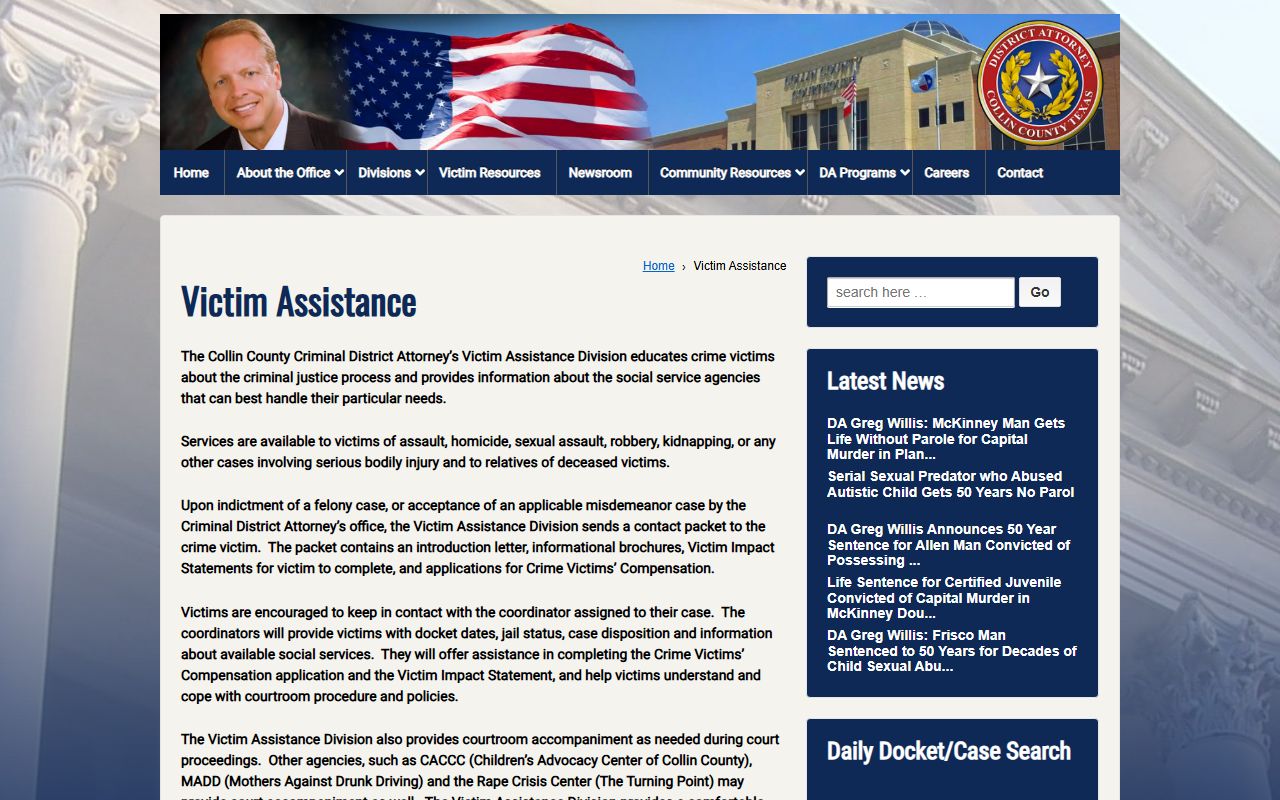
The DA office connects victims to notification tools so a release does not come as a surprise.
Searching Texas Department of Criminal Justice Records
If a Collin County case ended in prison time, the person likely moved to the Texas Department of Criminal Justice. TDCJ runs an offender search that covers people in state custody and can confirm a transfer out of the county jail. You can look up someone by name, by State ID, or by current TDCJ number. The tip from TDCJ is to use an asterisk for partial names, like Rich*, *son, or *123*. A details page supports release-related notifications.
| Field Label | Type | Required | Notes / Format |
|---|---|---|---|
| Name | Text | No | Search by name; asterisk wildcard supported |
| SID number | Text | No | Search by State ID number |
| Current TDCJ number | Text | No | Use the current number; older numbers use a separate search |
| Search by Previous TDCJ Numbers | Button | No | A separate search mode for prior numbers |
| View Details | Link | n/a | Opens more information and notification sign-up |
The state offender locator is the right tool when a county case turned into a prison sentence. It will not cover people who only passed through the county jail and were released locally.
Federal Bureau of Prisons Locator
Federal cases follow their own track. If the person was held on a federal charge, the Federal Bureau of Prisons inmate locator is the place to search. You can look by number or by name. The number search accepts a BOP Register Number, a DCDC Number, an FBI Number, or an INS Number. The name search uses first, middle, and last name, plus race, sex, and age to narrow results.
| Field Label | Type | Required | Notes / Format |
|---|---|---|---|
| Search by Number | Section | No | BOP Register, DCDC, FBI, or INS Number |
| Search by Name | Section | No | First, Middle, Last, plus Race, Sex, Age |
| Search | Button | Yes | Runs the search after fields are filled |
| Clear Form | Button | No | Clears all inputs |
You can run a federal search at the BOP inmate locator. If the result reads Released or Not in BOP Custody with no facility, the person is out of federal custody but may be in another system, on parole, or on supervised release.
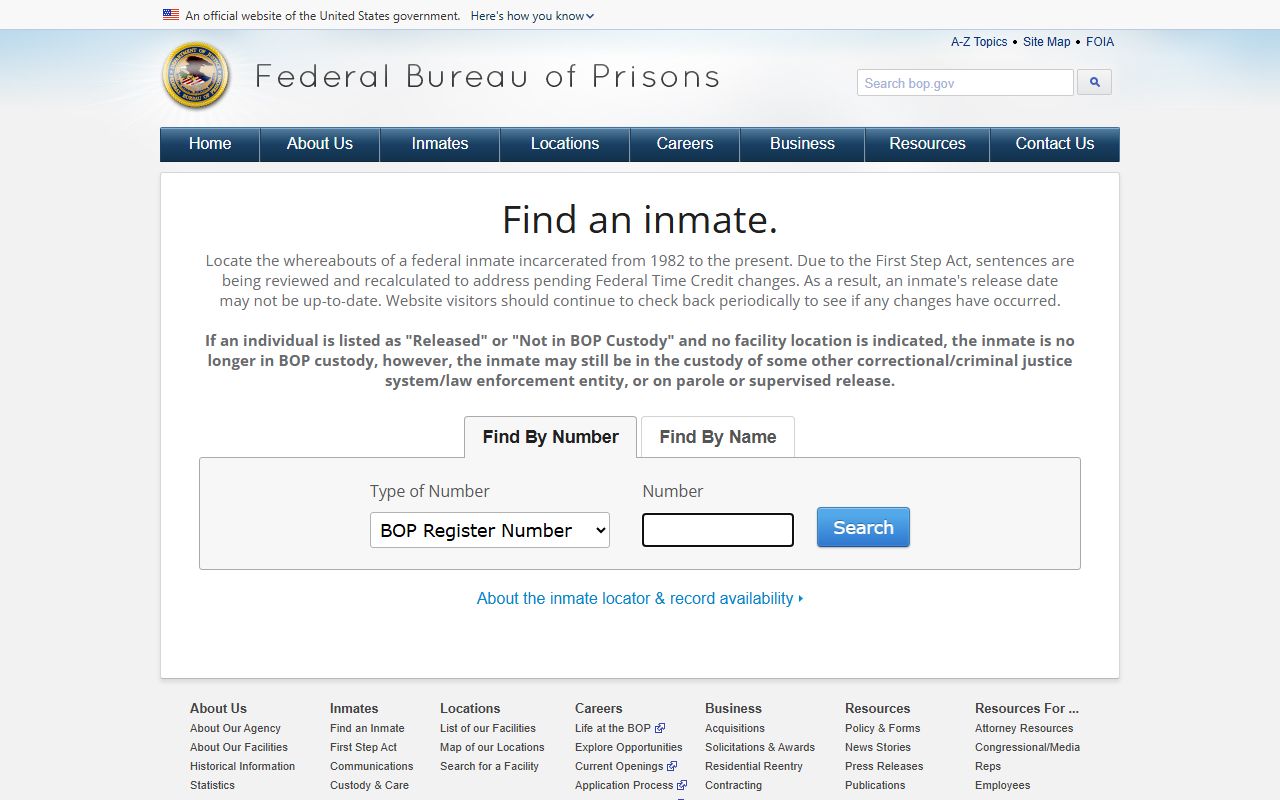
The federal locator only helps when a federal court handled the case, not a Collin County court.
Verifying a Release in Person or By Phone
Online tools do not always show a same-day change. To confirm a release that the roster no longer reflects, call the jail directly. The Detention Bureau line is (972) 547-5100. The jail information line in the visitation packet is (972) 547-5200.
The jail does not publish which door people exit from, whether bus tokens are available, or set release hours beyond the Admissions and Release process and the morning property pickup windows. Personal property follows the valuable and bulk property rules the jail uses for all inmates. For a person moved to state prison, verify through TDCJ. For someone in federal custody, verify through the BOP. Note: Release timing can shift with bond acceptance, case holds, and warrants, so confirm with the jail before you rely on a date.
The Texas Sex Offender Registry
Some released individuals must register as sex offenders. Texas Code of Criminal Procedure Chapter 62 requires adult and juvenile sex offenders to register with local law enforcement where they live. Registration includes a name, address, color photo, and the offense. Most of that information is public. The Texas Department of Public Safety runs the public registry, which you can search by name or by location around an address or city.
| Field Label | Type | Required | Notes / Format |
|---|---|---|---|
| Name search | Text | No | Search by the offender's name |
| Location/address search | Text/Map | No | Search around an address or city |
| Registry result profile | Link | n/a | Shows public registration information |
You can search the Texas DPS sex offender registry by name or neighborhood. Failure to register can bring felony charges.
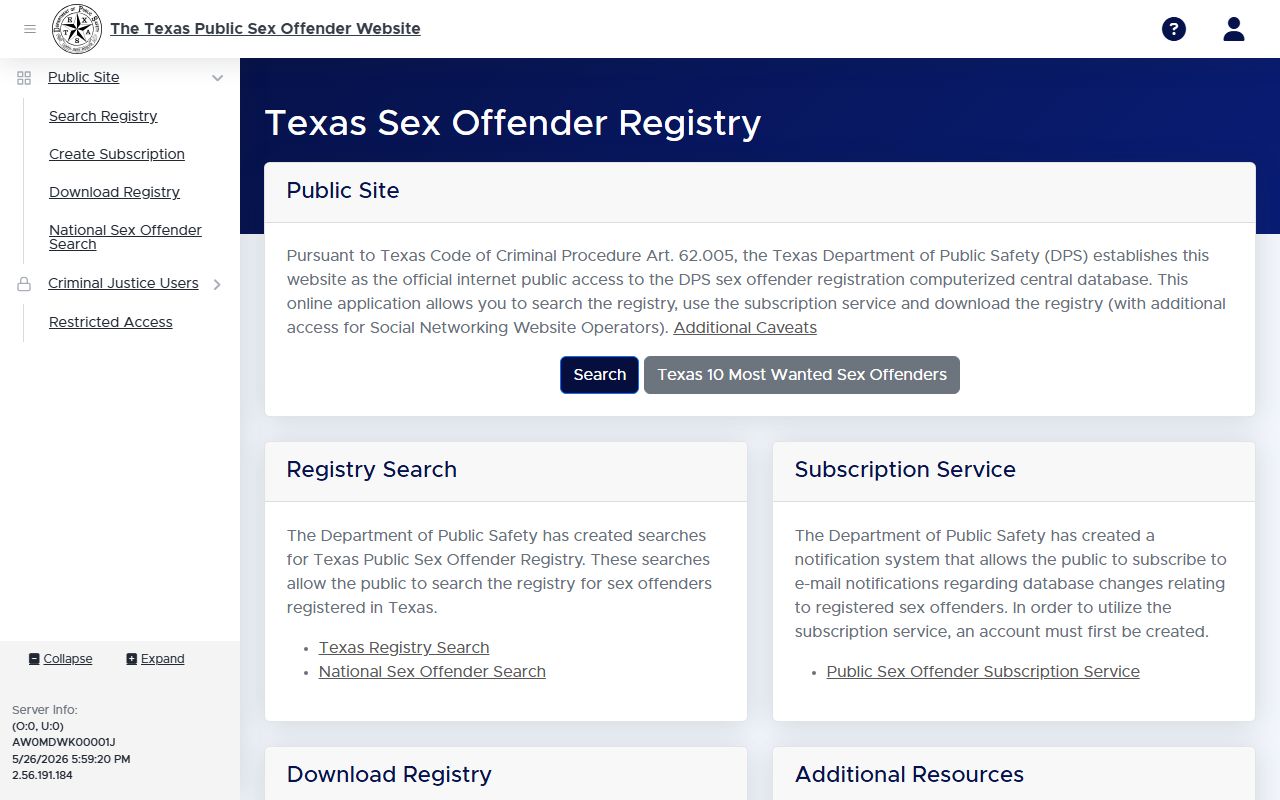
The registry is a separate file from the jail roster and stays public even after a person leaves custody.
The rules behind registration come from the DPS sex offender registration program, which explains who must register and for how long.
The program page lives at the Texas DPS sex offender registration program site.
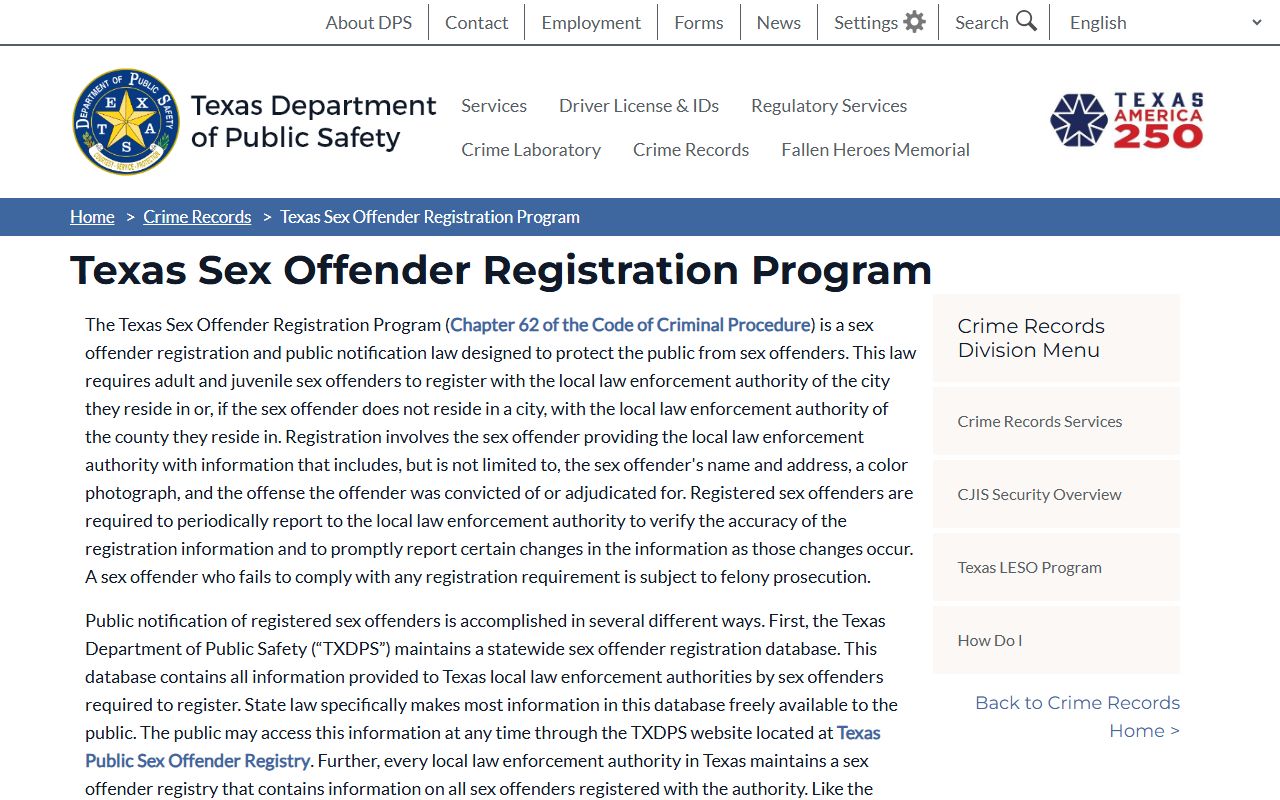
Reading the program rules helps make sense of what a registry profile means after release.
Parole and Probation Information
Not every release means full freedom. Many people leave custody onto parole or probation, also called community supervision. Parole for state prisoners is handled at the state level through TDCJ and the parole system, which sets conditions and monitors compliance. Probation from a Collin County court is supervised locally. A violation of either can send a person back into custody.
Parole means early release from a prison sentence under supervision, while probation is a court-ordered alternative to jail or prison time. Both carry rules, such as check-ins, treatment, fees, and travel limits. Breaking those rules can trigger a hearing and, in some cases, a return to custody. TDCJ provides statewide reentry and parole resources for people leaving state custody, and its details pages support custody notifications. If a parolee has an alleged violation, the supervising office handles reporting and review. For active arrest orders tied to a violation, the warrant records page covers how to check whether a warrant is out.
Reentry Resources in Collin County
Reentry starts before release. Collin County's jail programs focus on education, personal development, and reentry preparation, and they are voluntary and free. After release, several statewide resources can help with the next steps. The DA's office also points victims and the public toward support and notification tools.
- Collin County Inmate Programs, which build coping skills and a base for a stable return.
- TDCJ reentry and parole resources for people leaving state custody.
- Texas Law Help and the Texas State Law Library for self-help on expunction, nondisclosure, family, and ID issues.
- Legal Aid of NorthWest Texas for income-eligible residents who need civil legal help.
The DA office keeps a broader set of victim and community resources, including links tied to its notification system.
Those resources are listed on the Collin County DA victim resources page.
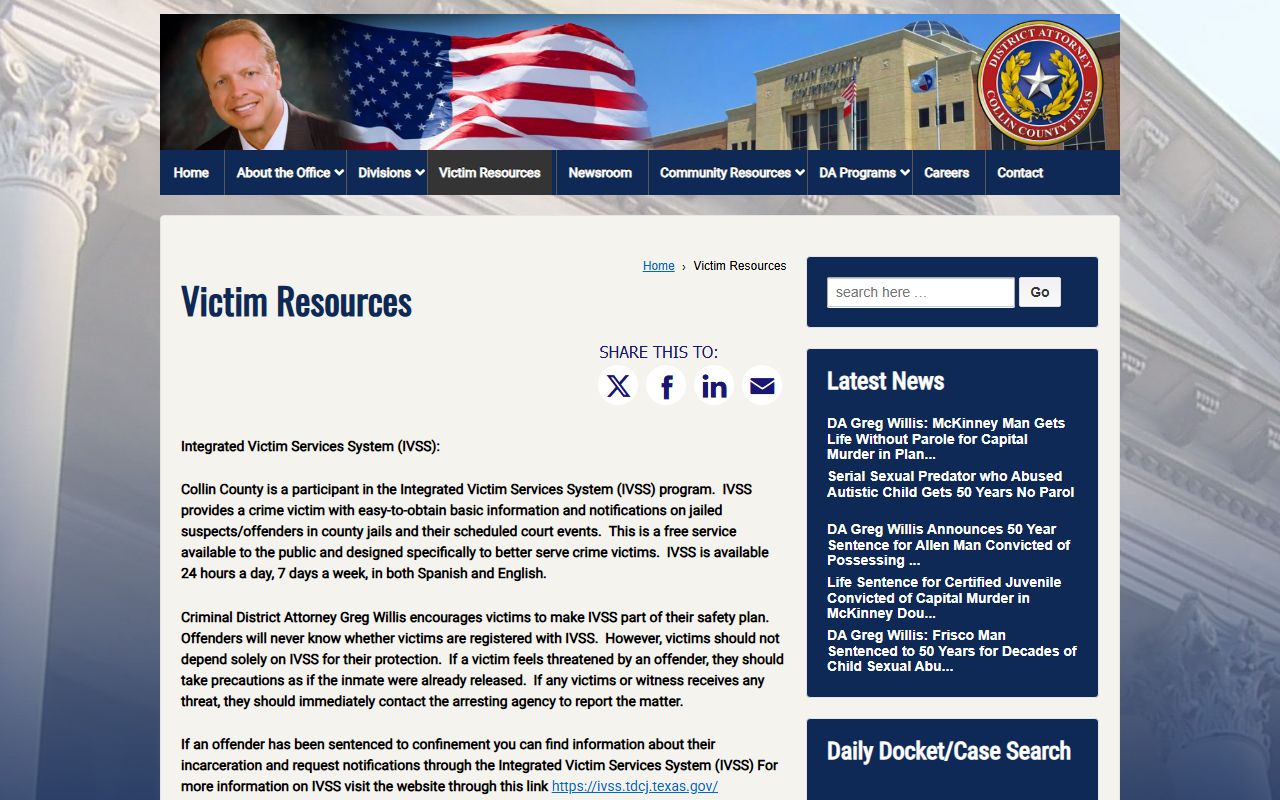
The page also explains the office's victim notification setup, which overlaps with release alerts.
Civil Rights Restoration After Release
A felony conviction in Texas affects certain rights, but some come back after the sentence ends. Voting is the clearest case. In Texas, a felony conviction blocks voting while a person is incarcerated, on parole, or on probation or community supervision. Rights are restored once the sentence is fully complete, with no extra application needed. Verify current rules with the Texas Secretary of State before you rely on a voting date.
Firearm rights restoration is far more complex under both state and federal law, and this is not legal advice. Driver-license reinstatement can depend on DPS holds, the OmniBase or failure-to-appear program, surcharges, and court compliance. For records help, expunction and nondisclosure can limit or clear qualifying records. Local self-help and legal aid groups assist with those filings, and the court records side is covered on the arrest records page.